BLOG EXCLUSIVE
These videos live here on the blog rather than my public YouTube feed so I can tackle whatever genre I feel like building. They’re set to non-monetized—if YouTube serves you an ad anyway, that’s on them. I tried.
I’ve always been fascinated by the stories behind the models I have built. Whether it’s imaganing Douglas Bader sitting in the Spitfire Mk. II I worked on that carried his “DB” markings, or imagining how a piece of scifi equipment might look based on some storyline running through my head, I like to think “real world”, even if that world is make believe.
And I’ve documented it quite a few times, either specifically, or more generically as part of an overall build or Deep Thoughts section. To me, this “narrative modeling” is simply a way to add to the fun I have in the build. And it gives me a way to explain – even if only to myself –why the model looks the way it does. It’s not just dirt and chips and stains, it’s all of that for a purpose.
I’ve said it often, “every chip has a story.”
What I have not done that I recall is to look at a specific model, and explore how the modeling informed the story, and how the story informed the model.
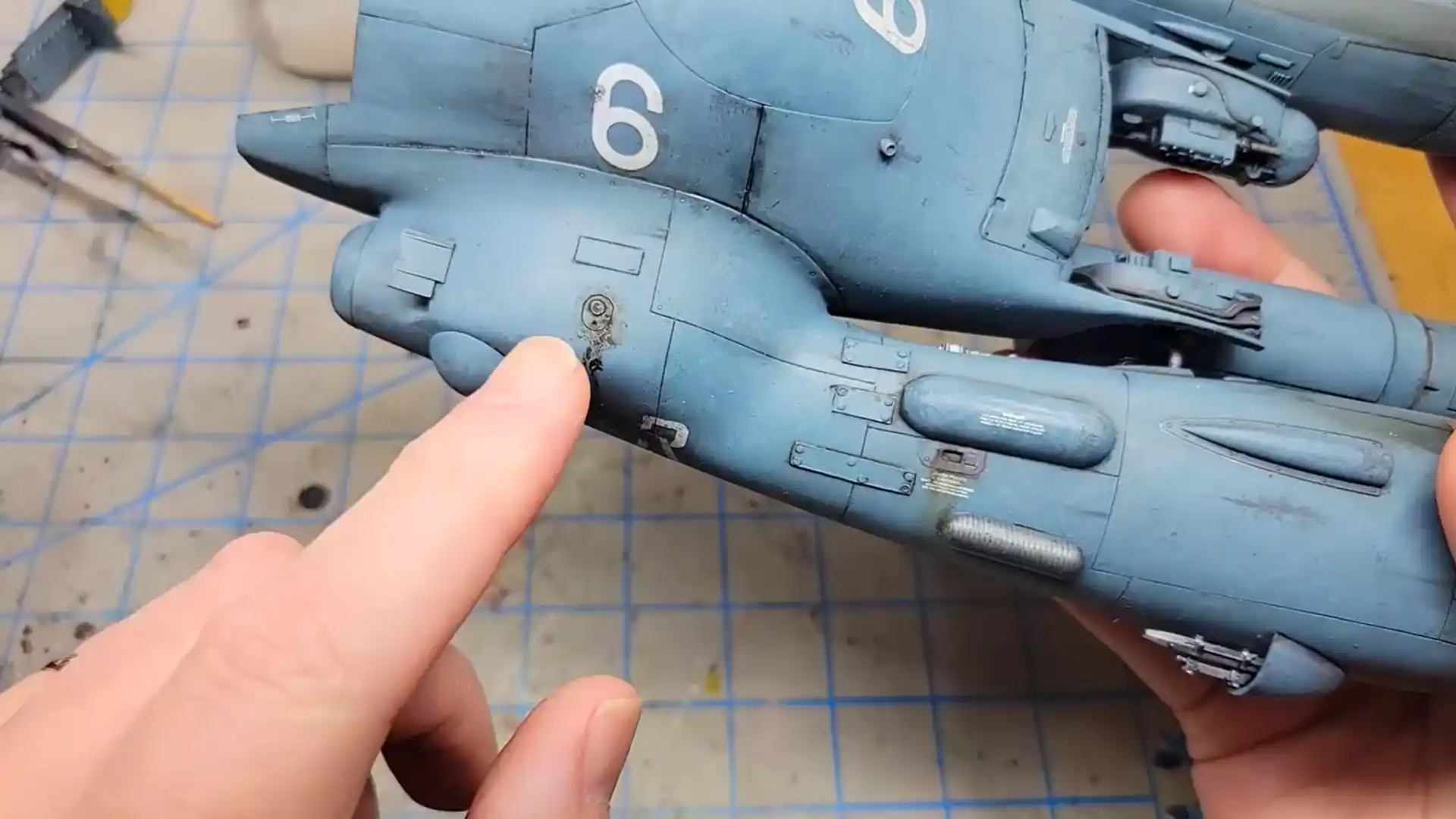
When I initially planned this Falke build, starting about 5 years ago, it was just a simple thought: Build a Falke, paint it PRU blue, and somehow make it look like a recon ship. Aside from that initial thought, I did not begin “researching my brain” for details.
Yet as I planned for the build earlier this year, I began to do that mental research. Why was it PRU Blue? What recon was it doing? How would it look if it were a specialized recon bird? What factors went into the mission?
The narrative story, Calculated Risk, started out simply as a series of notes detailing how the model should look, with a little research into why it looked that way. Yet as those notes expanded, my imagination kicked in, and a story began to emerge. As it grew, more questions needed to be answered.
Thus it went from a simple “which PRU Blue should I use?” to the more complicated “what happens to an aircraft starting a dive at 45 degrees angle at Mach 1.2 from 60,000 feet as it enters thicker air, and what are the airframe considerations regarding G-force involved for leveling off at <500ft AGL?”
And as the story expanded, it all translated into “how would this impact the visual appearance of the model?”
Now, there were a few things that the modeling dictated that changed the story. For example, the normal maneuver (based on my research) was for the aircraft to invert at altitude, and then go into its dive, and either on the way down, or just prior to pull out, roll back over. But this would present enormous airframe stress. And that stress would mean the twin booms would need some sort of reinforcement. And the most likely scenario was to roll over and then pull out at low altitude, thus introducing not only fore and after airframe stress, but also more torsion stress from the roll.
Which meant the airframe would need to be reinforced quite dramatically to not fly apart. Most of which would need to be internal to not induce drag. And THAT meant nothing to show in a modeling sense.
Thus the decision was made that the dive would be entered by just pitching nose down, thus inducing negative Gs. And visually to try and sell this notion (even if to myself only) the airframe reinforcement would need to be external.
And to explain THAT meant a short timeline for the story. There couldn’t be much time to do a “proper” job…
It got to the point that I found myself doing much of the very same mission planning that my team would have done for a real world night deception mission in Mogadishu in June 1993. Every new thought required more questions, more obstacles, more problems to solve. One new element often branched off four new considerations. Every consideration had an element of planning to recover from the unexpected. And for my PRU Falke narrative most of that was discarded to simply try and move the story along.
Now, I’m not saying you need to go to this level of detail in planning a build. “The SAFS was operating on a rainy day and fell in the mud” can be more than enough.
Still, even if your goal is not to write a story, rabbit chasing the notes can be a rewarding process that just makes a build all that more fun and satisfying.
At the very least, it lets me mentally justify the dozens of hours that have gone into this project’s writing alone… not to mention the modeling.
That’s what I tell myself at least.
Leave a Reply